

EV vs Petrol Car: Total Cost of Ownership in New Zealand 2026
The question used to be simple: petrol or diesel? In 2026, the real decision for Kiwi drivers is whether to go electric — and whether the numbers actually stack up.
Electric vehicles have never been more visible on New Zealand roads. But the economics of EV ownership have shifted significantly over the past two years. The Clean Car Discount is gone. Road user charges (RUCs) now apply to all EVs. ACC levies for electric vehicles have surged. And with the current Middle East conflict pushing petrol past $3.30 a litre nationally — with some Auckland stations hitting $4.00 — the fuel equation is changing by the week.
So, what does it actually cost to own an EV versus a petrol car in New Zealand right now? Not just the sticker price — but the total, all-in cost of ownership over five years, including fuel, insurance, registration, servicing, tyres, and depreciation.
In this guide, we compare the total cost of owning an EV against a petrol vehicle. If you're also considering a hybrid, check out our companion guide: EV vs Hybrid — Total Cost of Ownership NZ 2026.
If you haven’t compared your car insurance recently, start with a free Quashed Market Scan to see how your premium stacks up against 10+ NZ insurers in under two minutes — whether you drive electric or petrol.
This article provides general information only and does not constitute legal or financial advice. Insurance policies and vehicle costs vary between providers. For full details, refer to Quashed’s terms and conditions.
Step 1. Compare the Purchase Price

EVs Are Getting Cheaper — But Still Cost More Upfront
The purchase price remains the single biggest difference between electric and petrol vehicles. While entry-level EVs have dropped substantially — the Dongfeng Box launched in late 2025 at under $27,000, and the BYD Atto 1 starts at $29,990 — these are still more expensive than comparable petrol hatchbacks like the Suzuki Swift (from $25,990) or the petrol MG ZS (from $24,990).
At the mid-range, the gap widens. The electric MG ZS EV starts at $40,990, while its petrol sibling is $16,000 cheaper. The popular Tesla Model Y starts at around $55,000.
The Clean Car Discount, which provided rebates of up to $7,015 on new EVs, was discontinued on 31 December 2023. That subsidy made EVs significantly more competitive on sticker price — and its removal has contributed to a sharp decline in EV sales, with electric vehicles dropping from roughly one in four new car sales in 2023 to about one in nine in 2025.
Used EVs: Where the Value Is
The used EV market tells a different story. Higher depreciation rates for electric vehicles (more on this in Step 6) mean second-hand EVs can represent strong value. A second-generation Nissan Leaf (2018–2025) with the larger 62 kWh battery can be found for around $30,000 — a fraction of its original price — with modern range and features intact.
For buyers willing to go used, the purchase price gap between EV and petrol narrows considerably.
Step 2. Fuel and Charging Costs: The EV’s Biggest Advantage

Home Charging vs the Petrol Pump
This is where EVs pull decisively ahead. The average EV uses approximately 18 kWh of electricity to travel 100 km. At an average home electricity rate of around 25 cents per kWh, that works out to roughly $4.50 per 100 km.
A typical petrol car uses around 8 litres per 100 km. Even before the current fuel crisis, with 91 octane averaging $2.53 a litre in late February 2026, that equated to roughly $20.24 per 100 km. With the national average now above $3.30 per litre (and significantly higher in some areas), the cost has blown out to $26 or more per 100 km.
On a dedicated off-peak EV electricity plan — such as those offered by Meridian or other providers — annual charging costs for an average driver (11,500 km per year) can be as low as $300 to $500 per year. The equivalent petrol cost ranges from around $2,300 per year at pre-crisis prices to $3,700 or more at the $4.00 per litre some Auckland drivers are currently paying.
Charging Infrastructure: Can You Actually Get Around NZ?
For many Kiwi drivers considering the switch to electric, the question is not just what it costs to charge — it’s whether they can charge when and where they need to.
New Zealand currently has approximately 1,800 public charge points, which is among the lowest charger-to-EV ratios in the OECD. Coverage is concentrated in major urban centres and along main state highways, but gaps remain — particularly in rural and remote areas. For drivers who rely on long-distance travel or live outside major centres, this is a real consideration.
The good news is that the network is expanding rapidly. In March 2026, the Government announced $52.7 million in zero-interest loans to ChargeNet and Meridian Energy, backed by $60 million in private co-investment, to deliver over 2,500 new public charge points — including 1,374 DC fast chargers along highways and 1,200 AC chargers at workplaces and residential areas. The Government has committed to 10,000 public chargers by 2030.
For day-to-day use, most EV owners charge at home overnight and rarely need public infrastructure. A standard home charger or even a regular wall socket is sufficient for typical daily driving. Public charging becomes important primarily for road trips and longer journeys.
To plan a trip or check charger locations near you, the best resources are:
PlugShare NZ Map — A community-sourced map showing all public chargers across every network in New Zealand, with real-time availability, user reviews, and pricing.
ChargeNet Map — New Zealand’s largest fast-charging network, with over 520 rapid charging points from Cape Reinga to Bluff.
NZTA Journey Planner (EV Chargers) — Waka Kotahi’s official tool for planning EV-compatible routes across New Zealand.
If you mostly drive within your city and can charge at home, charging infrastructure is unlikely to be a barrier. If you regularly drive long distances in rural areas, it’s worth checking charger coverage along your usual routes before committing to an EV.
But Add Road User Charges
Since 1 April 2024, all battery electric vehicles must pay road user charges (RUCs) of $76 per 1,000 km, the same rate as diesel vehicles. At 11,500 km per year, that adds approximately $874 in annual costs, plus admin fees.
Petrol vehicles do not pay RUCs directly — their road contribution is embedded in the fuel excise duty at the pump, which currently works out to roughly $64 per 1,000 km for a car using 8 litres per 100 km.
Even with RUCs factored in, driving an EV charged at home remains substantially cheaper per kilometre than petrol. However, if you rely heavily on public DC fast chargers (40–60 cents per kWh), the cost gap narrows significantly.
Annual Fuel and Road Cost Comparison (11,500 km)
Cost Category | EV (Home Charging) | Petrol Car |
Energy / Fuel | $400–$520 | $2,300–$3,700 |
Road User Charges | ~$874 | Included in fuel price |
Total Annual Road Cost | $1,274–$1,394 | $2,300–$3,700 |
Note: Petrol cost based on 8 L/100 km at $2.53/L (pre-crisis national average) to $4.00/L (current Auckland peak). EV cost based on 18 kWh/100 km at home rates. Actual costs depend on your vehicle, driving habits, and electricity plan.
Step 3. Registration, WoF, and ACC Levies

Registration and licensing costs are not the same for EVs and petrol vehicles — and the gap has widened.
Rego and ACC: EVs Now Pay More
As of 1 January 2026, annual registration (licensing) fees for a private passenger vehicle are:
Petrol: $172.97 per year (12 months).
Electric or Diesel: $241.59 per year (12 months).
That is roughly 40% more for EV owners. On top of this, ACC levies for EVs increased by almost 160% from 1 July 2025, rising from $42.09 to $109.05 per year. Petrol vehicle owners saw a smaller increase, from $42.09 to $49.38.
WoF: Same for Both
A Warrant of Fitness (WoF) is required for all vehicles and costs the same regardless of fuel type — typically $50 to $80 depending on the provider. Vehicles under six years old require a WoF annually; older vehicles require one every six months.
For a full breakdown of all registration and licensing costs, see Quashed’s guide to Car Ownership Costs NZ 2026.
Step 4. Insurance: EVs Typically Cost More to Insure

Car insurance is one of the largest ongoing costs of vehicle ownership, and it is an area where EVs are consistently more expensive than their petrol equivalents.
Why EV Insurance Costs More
Quashed’s Market Scan data shows that EVs attract higher comprehensive insurance premiums than comparable petrol models. In a standardised comparison (same driver profile, same excess), the Tesla Model Y’s average insurance cost of $2,800 is approximately 40% higher than a petrol Subaru Forester 2.5i at $2,003 — and 29% higher than a Toyota RAV4 Hybrid at $2,172. Similarly, the BYD Atto 3 at $2,599 is about 7% more expensive to insure than a Mazda CX-5 at $2,423.
To illustrate this with live data, we ran a Quashed Market Scan on a BYD Atto 3 (sum insured $45,000) and a Mazda CX-5 (sum insured $40,000) using the same driver profile and $500 excess. The results:
BYD Atto 3: Monthly premiums ranged from $167.89 to $262.61 across six insurers, with an average of approximately $216 per month ($2,589 per year).
Mazda CX-5: Monthly premiums ranged from $137.49 to $221.93 across six insurers, with an average of approximately $176 per month ($2,106 per year).
That is a difference of roughly $483 per year on average — or $2,417 over five years — for two broadly comparable mid-range SUVs. The BYD’s average premium is 23% higher than the Mazda’s.
The key factors driving higher EV insurance premiums include:
Higher repair costs: EV components, especially batteries, require specialised tools and technicians.
Limited parts availability: Newer EV brands lack the deep NZ parts supply chains that Toyota and Mazda have built over decades.
Higher vehicle values: EVs generally cost more to purchase, which flows through to higher sums insured and higher premiums.
Battery replacement risk: A damaged battery can write off an otherwise repairable vehicle.
That said, not all EVs are expensive to insure. The Nissan Leaf, with its long track record and wide parts availability in NZ, averages around $1,067 per year for comprehensive cover — competitive with many petrol models.
For the full breakdown, see Quashed’s guide: Electric Vehicles — Do They Cost More to Insure? and our Tesla Insurance NZ 2026 guide.
What Kiwis Are Paying for Car Insurance
The average cost of comprehensive car insurance in New Zealand is $1,298 per year ($108 per month) as of Q4 2025, based on Quashed Index data. Auckland drivers pay more, averaging $1,510 per year. These figures reflect the overall market — EV-specific premiums sit above these averages.
Kiwis who compared their car insurance through Quashed found a cheaper policy 80% of the time, with average savings of $367 per year. Whether you drive an EV or a petrol car, comparing is the single most effective way to reduce your insurance costs. Run a free Quashed Market Scan to check your premium.
Step 5. Servicing and Maintenance
Fewer Moving Parts, Lower Maintenance Bills
This is a clear win for EVs. A typical electric vehicle has around 20 moving parts, compared to over 2,000 in an internal combustion engine. There are no oil changes, no spark plugs, no timing belts, no exhaust system, and no traditional transmission. Brake wear is also significantly reduced because EVs use regenerative braking, which recaptures energy and reduces friction on brake pads.
Most EV owners in New Zealand spend between $300 and $500 a year on maintenance, compared to $1,000 to $1,500 for a petrol car — roughly a third of the cost. AA data shows that EVs are 44% to 66% cheaper to maintain annually than petrol vehicles, and the major NZ car service chains generally charge less for their EV packages than for equivalent petrol-vehicle packages.
The Battery: The Elephant in the Room
The EV battery is the most expensive single component. Replacing a battery out of warranty can cost $10,000 to $30,000 or more depending on the vehicle. However, modern battery technology is proving far more durable than early models. Nickel-manganese-cobalt and lithium-iron-phosphate batteries typically lose only 1.6–2% of capacity per year. Most manufacturers offer battery warranties of 8 to 10 years.
For the vast majority of owners, battery replacement during the first ownership cycle is not a realistic cost — but it is a factor to consider if buying a used EV with an older battery.
Tyres: EVs Wear Them Faster
EVs are heavier than equivalent petrol cars (due to the battery pack) and deliver instant torque, both of which accelerate tyre wear. EV-specific tyres also tend to cost more. This is a smaller cost category, but it can add $200 to $400 per year in additional tyre expenses over a petrol vehicle.
Step 6. Depreciation: The Hidden Cost That Changes Everything
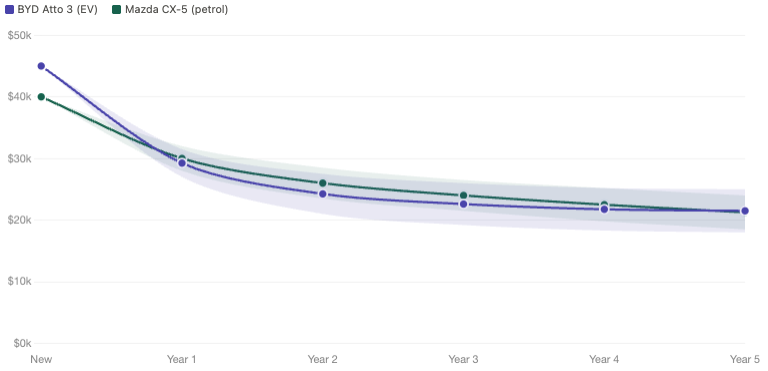
Depreciation is a large cost of car ownership — and it is the area where EVs have historically performed worst.
EVs Depreciate Faster Than Petrol Cars
All new cars lose value the moment they leave the lot, but EVs lose it faster. First-year depreciation for a new EV in New Zealand typically falls in the range of 30–40%, depending on the make, model, and whether you're looking at trade-in or private sale values. A new petrol car, by comparison, typically loses 20–30% in the same period.
In dollar terms, a $45,000 EV might be worth $27,000–$31,500 after the first year, while a $40,000 petrol car might hold $28,000–$32,000. Beyond year one, depreciation slows for both vehicle types, but the gap tends to persist. Over a five-year ownership period, a mid-range EV purchased new could lose anywhere from $20,000 to $27,000 in value, compared to roughly $16,000 to $22,000 for a comparable petrol car. That difference — potentially $5,000 to $7,000 — is enough to offset a portion of the EV's fuel savings, though the gap is narrowing as the used EV market matures.
Several factors drive this faster depreciation:
Rapid technology cycles: New EV models with better range and features make older models less desirable.
Battery anxiety: Buyers worry about degradation, even when modern batteries hold up well.
End of subsidies: The removal of the Clean Car Discount reduced demand for new EVs, pushing down used values.
Introduction of RUCs: Added running costs make EVs less attractive on the second-hand market.
However, the Motor Industry Association expects EV resale values to stabilise as the market matures and dealer confidence grows. Franchise resellers are gaining more experience with EVs and finding that battery degradation concerns have been overstated for modern vehicles.
What This Means for Total Cost of Ownership
If you buy a new EV and sell it within three years, depreciation alone can wipe out several years’ worth of fuel savings. However, if you buy a used EV (which has already absorbed the steepest depreciation) or hold the vehicle for five years or more, the running cost savings accumulate and the total cost of ownership tilts in the EV’s favour.
Step 7. Environmental Impact: Is an EV Actually Better for the Planet?

Total cost of ownership is not just measured in dollars. For many Kiwi buyers, the environmental case is part of the equation. But the picture is more nuanced than “EV = green, petrol = bad.”
Tailpipe Emissions: EVs Win Decisively
A battery electric vehicle produces zero tailpipe emissions. A typical petrol car in New Zealand emits approximately 180–200 grams of CO₂ per kilometre. Over 11,500 km per year, that adds up to roughly 2.1 to 2.3 tonnes of CO₂ annually from the exhaust alone.
An EV charged from the New Zealand grid produces significantly less. New Zealand generates over 80% of its electricity from renewable sources — primarily hydro, geothermal, and wind. This makes the carbon intensity of NZ grid electricity among the lowest in the world, meaning EVs charged here produce far fewer lifecycle emissions than in countries that rely heavily on coal or gas for power generation.
But What About Manufacturing Emissions?
Manufacturing an EV — particularly the battery — is more carbon-intensive than manufacturing a comparable petrol car. Estimates vary, but producing an EV battery typically generates between 6 and 12 tonnes of CO₂ equivalent, depending on the battery size, chemistry, and where it is manufactured. A petrol car’s manufacturing footprint is generally lower upfront.
However, the manufacturing deficit is recovered through lower operating emissions. In a country like New Zealand, with its high share of renewable electricity, the “carbon payback period” — the point at which an EV’s total lifecycle emissions fall below those of a comparable petrol car — is typically estimated at two to four years of average driving. After that, every additional kilometre driven in the EV is a net emissions saving.
End-of-Life Considerations
EV battery recycling is still a developing industry, but it is improving rapidly. Used EV batteries that are no longer suitable for driving can be repurposed for stationary energy storage. And as recycling infrastructure scales up globally, a greater proportion of battery materials — including lithium, cobalt, and nickel — will be recovered and reused, further reducing the lifecycle environmental footprint.
For Kiwi drivers who prioritise reducing their carbon footprint, an EV charged from the NZ grid is the clear winner. New Zealand’s renewable electricity advantage means the environmental case for EVs is stronger here than in most other countries.
Step 8. The Five-Year Total Cost Comparison

Below is a five-year total cost of ownership comparison between a BYD Atto 3 (EV) and a Mazda CX-5 (petrol), both purchased new. The table shows the net cost of ownership — that is, what you actually spend over five years after accounting for the vehicle’s estimated resale value. Insurance figures are based on actual Quashed Market Scan data using the same driver profile, $500 excess, and comprehensive cover. Other figures are indicative and will vary based on the specific vehicle, driver profile, location, and market conditions.
Running Cost Category | EV (BYD Atto 3) | Petrol (Mazda CX-5) |
Fuel / Charging | $2,000–$2,600 | $11,500–$15,200 |
Road User Charges | ~$4,370 | Included in fuel |
Registration + ACC | ~$1,753 | ~$1,112 |
WoF | ~$375 | ~$375 |
Insurance | ~$12,950 (avg $2,589/yr) | ~$10,530 (avg $2,106/yr) |
Servicing + Maintenance | ~$1,500–$2,500 | ~$5,000–$7,500 |
Tyres | ~$2,500 | ~$2,000 |
Estimated 5-Year Running Costs | ~$25,448–$27,048 | ~$30,517–$36,717 |
Note: Running costs only — excludes purchase price and depreciation (see Step 6). Insurance from Quashed Market Scan (March 2026, same driver profile, $500 excess). Petrol at $2.53–$3.30/L; EV at ~25c/kWh home charging. Actual results will vary.
What the Numbers Tell Us
On pure running costs, the EV is the clear winner. Over five years, the BYD Atto 3 costs approximately $25,400 to $27,000 to run, compared to $30,500 to $36,700 for the Mazda CX-5. That is a running cost saving of roughly $5,000 to $9,700 in favour of the EV — driven overwhelmingly by the difference in fuel costs.
At $3.30 per litre, a petrol car burns through roughly $15,200 in fuel over five years, compared to just $2,000–$2,600 to charge an EV at home. That $12,000+ fuel saving is the EV's most powerful advantage, and it more than offsets the EV's higher insurance, registration, and road user charges.
But Factor In Depreciation
Running costs are only part of the picture. As covered in Step 6, EVs currently depreciate faster than petrol cars. A mid-range EV purchased new could lose $20,000 to $27,000 in value over five years, compared to $16,000 to $22,000 for a comparable petrol car — a gap of roughly $4,000 to $5,000.
When you combine running costs with depreciation, the picture tightens. At pre-crisis petrol prices around $2.53 per litre, the running cost saving (~$5,000) roughly matches the depreciation gap (~$4,000–$5,000), putting the two vehicles at near parity. At current prices above $3.30 per litre, the running cost saving (~$9,700) comfortably exceeds the depreciation gap, and the EV is the cheaper option over five years for a driver who charges at home.
The EV’s advantage grows further if you:
Drive more than the average 11,500 km per year (every additional kilometre disproportionately favours the EV).
Buy a used EV (significantly reducing the depreciation hit).
Charge on an off-peak electricity plan (reducing annual charging costs to as low as $300).
Shop your insurance aggressively — the cheapest Market Scan quote for the BYD Atto 3 was $167.89/month versus $137.49/month for the Mazda, narrowing the five-year insurance gap from ~$2,420 to ~$1,824.
The tipping point depends on three variables: how long you keep the car (longer favours EVs), how many kilometres you drive (more driving favours EVs), and the price of petrol (higher prices favour EVs).
With petrol above $3.00 per litre and rising, the case for EVs on a pure running-cost basis has never been stronger in New Zealand. But the total cost equation requires looking at the full picture.
Step 9. Compare Your Car Insurance Before You Buy
Whether you are buying an EV, sticking with petrol, or simply haven’t reviewed your current policy in over 12 months, insurance is one of the easiest costs to reduce — if you compare.
Quashed’s data shows that Kiwis who don’t shop around for insurance pay an average loyalty tax of $1,351 per year across their car, house, and contents policies combined. On car insurance specifically, Kiwis who compared found a cheaper policy 80% of the time, saving an average of $367 per year.
As the Market Scan data in this article shows, the spread between the cheapest and most expensive quote for the same vehicle can be significant. For the BYD Atto 3, the difference between the cheapest and most expensive insurer is $94.72 per month — or $1,137 per year. For the Mazda CX-5, the spread is $84.44 per month — or $1,013 per year. This underscores why comparing is essential.
The free Quashed Market Scan compares your car insurance against 10+ NZ insurers in under two minutes. Two minutes could save you hundreds — and that saving offsets real ownership costs no matter what you drive.
Final Verdict: Which Is Cheaper to Own?

There is no universal answer. The cheapest option depends on your circumstances.
EVs tend to win on total cost of ownership if you buy used (avoiding the worst depreciation), charge at home on an off-peak plan, drive a high number of kilometres, and hold the car for five years or more. The current fuel crisis amplifies this advantage. At current petrol prices above $3.30 per litre, a new EV charged at home is already close to — or at — cost parity with a comparable petrol car over five years.
Petrol cars tend to win on total cost of ownership if you buy new and sell within three years, drive lower annual kilometres, or prioritise lower upfront purchase price, lower insurance costs, and lower registration fees.
Beyond dollars, EVs offer a clear environmental advantage in New Zealand thanks to the country’s largely renewable electricity grid. For drivers who factor carbon emissions into their decision, the EV’s lifecycle emissions are significantly lower — and the manufacturing carbon deficit is typically recovered within two to four years of average driving.
Charging infrastructure remains a practical consideration. New Zealand’s public charging network is growing rapidly, with over 2,500 new charge points announced in March 2026, but coverage gaps persist in rural areas. For urban drivers who can charge at home, this is not a barrier. For rural drivers or frequent long-distance travellers, it’s worth checking charger coverage along your usual routes.
In both cases, the single easiest saving available to any driver is comparing car insurance. Run a free Quashed Market Scan to see how your premium compares — it takes two minutes, it’s free, and it could save you hundreds.
Considering a hybrid instead? See our companion guide: EV vs Hybrid — Total Cost of Ownership NZ 2026, where we compare electric vehicles against hybrids to see which middle ground offers the best value for Kiwi drivers.
Related Reading
The Quashed team has the guides you need to make smarter insurance decisions at every stage:
Electric Vehicles: Do They Cost More to Insure? — A deep dive into EV insurance costs versus petrol and hybrid vehicles.
Tesla Insurance NZ 2026: Understanding Premium Costs for Your EV — A comprehensive guide to insuring a Tesla in New Zealand.
Car Ownership Costs NZ 2026: Registration, Insurance & Total Running Costs Explained — The full breakdown of rego, WoF, ACC levies, and insurance costs for every vehicle type.
Average Car, House, and Contents Insurance Cost NZ 2026: Monthly Payment Guide — The latest Quashed Index Q4 2025 data on NZ insurance premiums.
Comprehensive vs Third Party Fire & Theft vs Third Party (Full NZ Breakdown) — A full breakdown of the three levels of car insurance cover.
Cheap Car Insurance NZ 2026: Proven Ways to Lower Your Premium — Practical strategies to reduce your premium without cutting cover.
Comparing Insurance Costs for the Most Popular Cars in NZ — See how different vehicles affect your insurance premiums.
Car Insurance in New Zealand: A Consumer Guide — The essentials of car insurance in New Zealand, from policy types to claims.
Frequently Asked Questions: EV vs Petrol Total Cost of Ownership NZ
What is the average cost of an EV in NZ?
The cheapest new EV in New Zealand is currently the Dongfeng Box at $26,990. The BYD Atto 1 starts at $29,990, and the popular BYD Atto 3 mid-range SUV starts at around $45,000. The Tesla Model Y starts at approximately $55,000. Used EVs are significantly cheaper — a second-generation Nissan Leaf with modern range can be found for around $30,000. Overall, new EVs still cost more upfront than comparable petrol models, but the gap is narrowing.
Is an EV cheaper to own than a petrol car in New Zealand?
Based on Quashed's research, we believe EVs are cheaper than petrol cars for most Kiwi drivers. EVs are significantly cheaper to fuel and maintain, and at current petrol prices above $3.30 per litre, a new EV charged at home is roughly equivalent to — or already cheaper than — a comparable new petrol car over five years. That said, EVs are more expensive to purchase, insure, and register, and they currently depreciate faster. Over shorter ownership periods, petrol cars are often cheaper due to lower depreciation and upfront costs.
How much does it cost to charge an EV at home in NZ?
At an average home electricity rate of around 25 cents per kWh, charging an EV costs approximately $4.50 per 100 km. On a dedicated off-peak EV plan, annual charging costs for an average driver (11,500 km) can be as low as $300. At standard home rates, the figure is closer to $500. This compares to $2,300 to $3,800 or more per year in petrol costs for a comparable vehicle.
Do EVs cost more to insure than petrol cars?
Generally, yes. Quashed data shows EVs typically attract 7–40% higher comprehensive insurance premiums than comparable petrol vehicles, depending on the make and model. For example, the average Market Scan premium for a BYD Atto 3 ($45,000 sum insured) is $2,589 per year, compared to $2,106 for a Mazda CX-5 ($40,000 sum insured) — a difference of 23% using the same driver profile. This is driven by higher repair costs, specialised parts, and higher vehicle values. However, established models like the Nissan Leaf can be very affordable to insure. Run a free Quashed Market Scan to compare insurance for your specific vehicle.
Do EVs still pay road user charges in NZ?
Yes. Since 1 April 2024, all battery electric vehicles pay RUCs of $76 per 1,000 km, the same rate as diesel vehicles. Plug-in hybrids pay a reduced rate of $38 per 1,000 km. Standard petrol hybrids (non-plug-in) are exempt from RUCs as they pay fuel excise at the pump.
Do EVs depreciate faster than petrol cars?
Currently, yes. Based on NZ resale data, new EVs have been losing 30–40% of their value in the first year, compared to 20–30% for petrol cars. The industry expects this gap to narrow as the EV market matures and dealer confidence in used EV battery longevity improves. Buying a used EV allows you to avoid the steepest depreciation.
What is the average cost of car insurance in New Zealand?
The average cost of comprehensive car insurance in New Zealand is $1,298 per year ($108 per month) as of Q4 2025, based on Quashed Index data. Auckland drivers pay an average of $1,510 per year. EV-specific premiums typically sit above these national averages. Quashed users who compared found cheaper cover 80% of the time, saving an average of $367 per year. Run a free Quashed Market Scan to see how your premium compares.
Are EVs better for the environment in New Zealand?
Yes. New Zealand generates over 80% of its electricity from renewable sources, which means EVs charged from the NZ grid produce significantly fewer lifecycle carbon emissions than petrol vehicles. While manufacturing an EV battery is more carbon-intensive upfront, the “carbon payback period” in New Zealand is typically estimated at two to four years of average driving. After that, every additional kilometre in an EV is a net emissions saving compared to petrol.
Is New Zealand’s EV charging network good enough?
Generally, yes. New Zealand currently has approximately 1,800 public charge points, with over 2,500 more announced in March 2026. Coverage is strong in major urban centres and along main state highways, but gaps remain in rural and remote areas. For most urban drivers who charge at home overnight, public infrastructure is only needed for road trips. Apps like PlugShare and ChargeNet’s map can help you check coverage along your usual routes before deciding.
This article provides general information only and does not constitute legal or financial advice. Insurance policies and vehicle costs vary between providers. For full details, refer to Quashed’s terms and conditions.

