

EV vs Hybrid Car: Total Cost of Ownership in New Zealand 2026
In our companion article, EV vs Petrol Car: Total Cost of Ownership in New Zealand 2026, we compared the total cost of owning an electric vehicle against a petrol car in New Zealand. The verdict was clear: EVs are cheaper to run day-to-day, but higher purchase prices, steeper depreciation, and more expensive insurance mean the total cost of ownership picture is more nuanced than the fuel savings alone suggest.
But there is a third option that has quietly become the most popular choice on New Zealand roads — and it is the one most buyers overlook when the EV conversation dominates the headlines. That option is the hybrid.
Petrol hybrids accounted for almost 44% of all new passenger car registrations in New Zealand in 2025, according to NZ Transport Agency Waka Kotahi Motor Vehicle Register data, corroborated by Motor Industry Association (MIA) monthly reporting. For the first time, more than half of all new passenger cars sold had some form of electric powertrain — but it was conventional hybrids, not pure EVs, driving that shift. Pure battery electric vehicles represented just 5.6% of new sales, while plug-in hybrids (PHEVs) made up 5.0%.
The Toyota RAV4 Hybrid alone sold over 10,000 units in 2025, making it New Zealand’s best-selling vehicle for the second consecutive year. The Corolla Hybrid, Yaris Cross Hybrid, and Honda Jazz Hybrid all featured prominently in the top sellers. Kiwis are voting with their wallets — and they are choosing hybrids.
This guide compares a pure EV against a petrol hybrid across every cost category that matters: purchase price, fuel and energy costs, road user charges, registration and licensing, insurance, servicing and maintenance, and depreciation. If you are weighing up whether to go fully electric or take the hybrid middle ground, this is the comparison you need.
If you haven’t compared your car insurance recently, run a free Quashed Market Scan to compare your premium against 10+ NZ insurers in under two minutes — whether you drive an EV, hybrid, or petrol car.
This article provides general information only and does not constitute legal or financial advice. Insurance policies vary between providers. For full details, refer to Quashed’s terms and conditions.
Step 1. Understand the Three Types of Electrified Vehicle
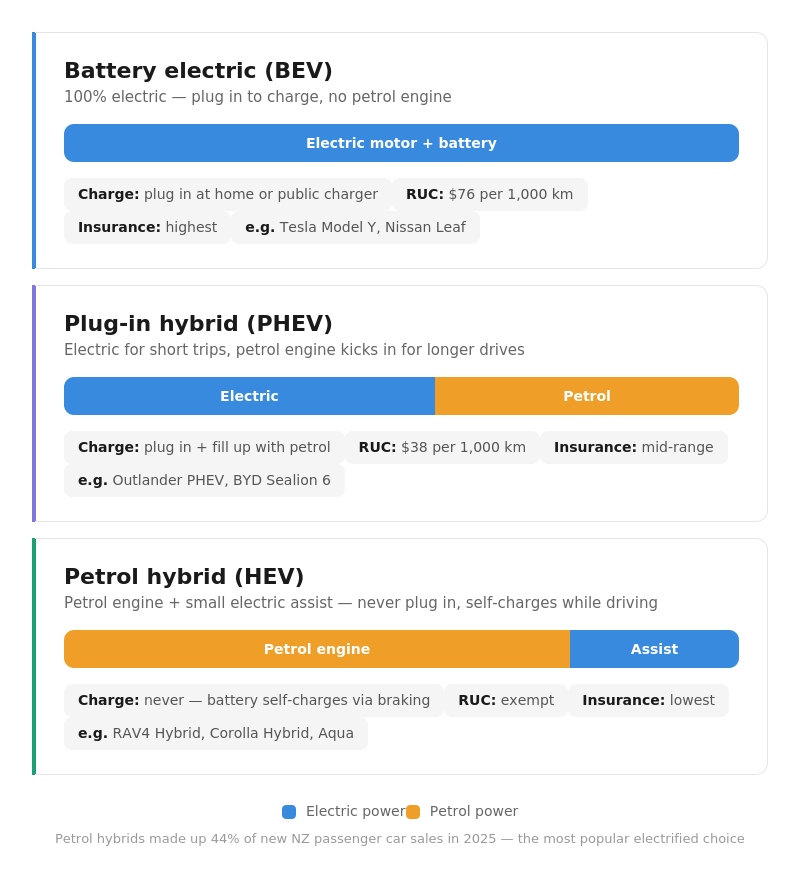
Battery Electric Vehicles (BEVs)
A BEV runs entirely on battery power. There is no petrol engine. You charge it at home, at work, or at a public charging station. Popular BEVs in New Zealand include the Tesla Model Y, Tesla Model 3, Nissan Leaf, and BYD Atto 3. BEVs produce zero tailpipe emissions and are the cheapest to fuel per kilometre — but they carry the highest purchase prices, the steepest insurance premiums, and require access to charging infrastructure.
Plug-in Hybrid Electric Vehicles (PHEVs)
A PHEV has both a petrol engine and a rechargeable battery. You can plug it in to charge and drive on electric power alone for a limited range (typically 40–120 km depending on the model), then switch to petrol for longer journeys. Popular PHEVs in New Zealand include the Mitsubishi Outlander PHEV, BYD Sealion 6, and Mazda CX-60 PHEV. PHEVs offer flexibility, but they pay road user charges (RUC) of $38 per 1,000 km on top of fuel excise duty, and their purchase prices tend to be higher than standard hybrids.
Petrol Hybrids (HEVs)
A petrol hybrid (HEV) combines a petrol engine with a small electric motor and battery. The battery recharges itself through regenerative braking and the engine — you never plug it in. The electric motor assists at low speeds and during acceleration, reducing fuel consumption significantly compared to a pure petrol car. At idle — such as when stopped at traffic lights or in slow-moving traffic — most hybrids automatically shut off the petrol engine entirely and run on electric power alone, eliminating fuel consumption and emissions while stationary. Popular HEVs in New Zealand include the Toyota RAV4 Hybrid, Toyota Corolla Hybrid, Toyota Yaris Cross Hybrid, Toyota Aqua, and Honda Jazz Hybrid.
For this article, when we refer to “hybrids” we mean petrol hybrids (HEVs) unless otherwise specified. We will refer to plug-in hybrids as PHEVs explicitly.
Step 2. Compare the Purchase Price

The upfront purchase price remains the single largest cost in any vehicle’s total cost of ownership. Here is how three popular models compare at new retail pricing in New Zealand as of early 2026:
Specs | Tesla Model Y (BEV) | Toyota RAV4 Hybrid (HEV) | Mitsubishi Outlander PHEV |
Base variant | $67,900 (RWD) | $49,990 (GX FWD) | ~$55,990 |
Mid-spec variant | $77,900 (Long Range AWD) | $55,990 (GXL AWD) | ~$65,990 |
Vehicle type | Battery Electric | Petrol Hybrid (HEV) | Plug-in Hybrid (PHEV) |
Source: Tesla NZ confirmed pricing (Autotalk, March 2026). Toyota NZ confirmed pricing (EVs & Beyond, January 2026). Mitsubishi NZ pricing indicative based on current range. All prices exclude on-road costs unless stated.
The RAV4 Hybrid enters the market at around $18,000 less than a comparable Tesla Model Y. That price gap alone is significant — it represents years of fuel savings that an EV buyer needs to recoup before the running cost advantage starts to pay off. The Outlander PHEV sits between the two, offering a middle ground on both price and running costs.
The Clean Car Discount, which provided rebates of up to $7,015 on new EVs, was discontinued on 31 December 2023. There are currently no government subsidies to offset the higher purchase price of EVs or PHEVs in New Zealand.
Step 3. Compare Fuel and Energy Costs

This is where EVs have traditionally dominated the ownership cost conversation — and they still hold an advantage. But hybrids have narrowed the gap significantly, especially as petrol prices have surged in 2026.
The Numbers
Based on an annual driving distance of 11,500 km (the NZ average) and current 2026 pricing:
Cost Category | BEV (e.g. Tesla Model Y) | HEV (e.g. RAV4 Hybrid) | PHEV (e.g. Outlander PHEV) |
Fuel economy | ~15 kWh/100 km | ~4.8 L/100 km | ~2.1 L/100 km + electric |
Energy cost per 100 km | ~$4.50 (home charging) | ~$15.84 (@ $3.30/L) | ~$6.93 (@ $3.30/L) |
Annual energy cost | ~$518 | ~$1,822 | ~$797 |
RUC (annual) | $874 ($76/1,000 km) | $0 (exempt) | $437 ($38/1,000 km) |
Total annual fuel + RUC | ~$1,392 | ~$1,822 | ~$1,234 |
Sources: Electricity cost based on national average residential rate of ~30c/kWh (home overnight charging). Petrol price based on national average 91 octane of ~$3.30/L as of late March 2026 (MBIE/Gaspy data). RUC rates from NZTA. PHEV fuel economy based on blended driving (Canstar). Annual distance: 11,500 km.
What This Means
The BEV is still the cheapest to fuel in pure energy terms — home charging an EV costs roughly a third of what a hybrid spends on petrol. However, once you add road user charges of $76 per 1,000 km, the EV’s total annual fuel-plus-RUC cost rises to approximately $1,392. That narrows the gap with a hybrid to just $430 per year.
Critically, petrol hybrids (HEVs) are exempt from road user charges in New Zealand. Because they run on petrol, they already contribute to road funding through fuel excise duty at the pump. This is a major cost advantage that many buyers overlook. A RAV4 Hybrid owner does not need to buy a RUC licence, monitor their odometer to ensure they do not exceed their purchased distance, or display a RUC label on their windscreen — all of which are current legal requirements for EV and PHEV owners under the Road User Charges Act 2012.
PHEVs occupy the middle ground. Their blended fuel economy is excellent, but the $38 per 1,000 km RUC charge (because they can be plugged in) adds $437 per year on top of their fuel costs. Drivers who consistently charge their PHEV and do most driving on electric power will see lower fuel costs, but the RUC still applies regardless.
With petrol prices sitting at $3.30 or above nationally — and above $4.00 per litre at some Auckland stations as of late March 2026, according to Gaspy and NZ Herald reporting — the hybrid’s fuel efficiency is more valuable than ever. A RAV4 Hybrid averaging 4.8 L/100 km uses roughly half the fuel of a comparable petrol-only SUV. For tips on reducing your fuel bill further, see our guide: How to Save on Petrol in NZ 2026.
Step 4. Compare Registration and Licensing Costs

As we covered in our EV vs Petrol Car: Total Cost of Ownership in New Zealand 2026 article and in the Car Ownership Costs NZ 2026 guide, registration and licensing fees increased from 1 January 2026 as part of a two-year Government fee adjustment. Here is how the annual costs compare:
Fee Component | BEV (Electric) | HEV (Petrol Hybrid) |
12-month licensing fee | $241.59 | $172.97 |
ACC levy (annual) | $109.05 | $49.38 |
Total annual rego + ACC | ~$350.64 | ~$222.35 |
Sources: NZTA 2026 fee schedule (nzta.govt.nz). ACC motor vehicle levy rates effective 1 July 2025 (acc.co.nz). Fees include GST and online admin fee. The ACC levy for EVs increased approximately 160% from $42.09 to $109.05 from the 2025–26 financial year, while the petrol vehicle levy increased 17% from $42.09 to $49.38.
EVs now pay the same licensing fees as diesel vehicles — roughly 40% more than petrol vehicles — after the ACC levy discount for EVs ended on 1 July 2025. Petrol hybrids are classified as petrol vehicles for registration purposes, so they pay the lower petrol rate. This creates an annual difference of approximately $128 in favour of the hybrid.
For full details on registration and licensing costs, see Car Registration NZ: A Guide to Licensing Costs and Insurance Requirements.
Step 5. Compare Insurance Costs

Insurance is one of the most significant — and most frequently overlooked — differences in total cost of ownership between EVs and hybrids. Quashed’s own data tells a clear story.
What the Data Shows
Using Quashed’s Market Scan, we ran live comprehensive insurance quotes for all three vehicles in this comparison using a standardised driver profile. The results show a clear premium gap between EVs and hybrids:
Specs | Tesla Model Y (BEV) | Toyota RAV4 Hybrid (HEV) | Outlander PHEV |
Sum insured | $67,900 | $49,990 | $55,990 |
Cheapest monthly premium | $241.77/mo | $173.09/mo | $189.67/mo |
Most expensive monthly premium | $410.47/mo | $293.45/mo | $310.05/mo |
Average across available insurers | $327/mo ($3,926/yr) | $228/mo ($2,730/yr) | $243/mo ($2,913/yr) |
Difference vs RAV4 Hybrid | +$1,196/yr (+44%) | Baseline | +$183/yr (+7%) |
Source: Quashed Market Scan, March 2026. Profile: 30-year-old, NZ full licence, 5+ years driving experience, no accident history, Rosedale, Auckland. Comprehensive cover, $500 preferred excess. Average calculated across all available insurers for each vehicle. Actual premiums vary by individual profile, location, and insurer.
Why EVs Cost More to Insure
Three factors drive the premium gap between EVs and hybrids:
Higher vehicle values. EVs are generally more expensive to purchase than equivalent hybrids, which means higher sum insured amounts and therefore higher premiums.
Specialised repair requirements. EV repairs require specialist tools and certified technicians. The high-voltage battery system is particularly expensive to repair or replace, and even minor collision damage near the battery can result in disproportionately large repair bills. Newer EV manufacturers lack the large-scale parts networks that established brands like Toyota have built over decades.
Evolving risk profiles. EVs are still relatively new to New Zealand’s roads, and their full risk profile is still being understood by insurers. That uncertainty is priced into premiums. Hybrids, by contrast, share most of their mechanical components with well-established petrol models, making them familiar territory for insurers and repairers alike.
Hybrids: The Insurance Sweet Spot
Petrol hybrids benefit from the best of both worlds when it comes to insurance. They use Toyota’s (or Honda’s, or Mazda’s) well-established parts and repair networks, their battery systems are smaller and less costly than EV batteries, and the majority of their servicing and repair work can be carried out by any qualified mechanic using standard workshop equipment — unlike EVs, which require high-voltage certified technicians for any work involving the battery or electric drivetrain. The Toyota Prius — one of the longest-running hybrid models in the world — has an average comprehensive premium of around $1,232 per year, according to Quashed’s Guide to Toyota Prius Insurance in NZ. That is competitive with many standard petrol vehicles.
The average cost of comprehensive car insurance across New Zealand is $1,298 per year ($108 per month) as of Q4 2025, based on Quashed Index data. Auckland drivers pay more, with the regional average sitting at $1,510 per year ($126 per month).
Quashed’s platform data shows that Kiwis who compared their car insurance found a cheaper policy 80% of the time, with average savings of $367 per year. Whether you drive an EV, hybrid, or petrol car, the principle is the same: compare before you commit.
Run a free Quashed Market Scan to see how your EV or hybrid insurance premium compares against 10+ NZ insurers. It takes two minutes and could save you hundreds.
Step 6. Compare Servicing and Maintenance
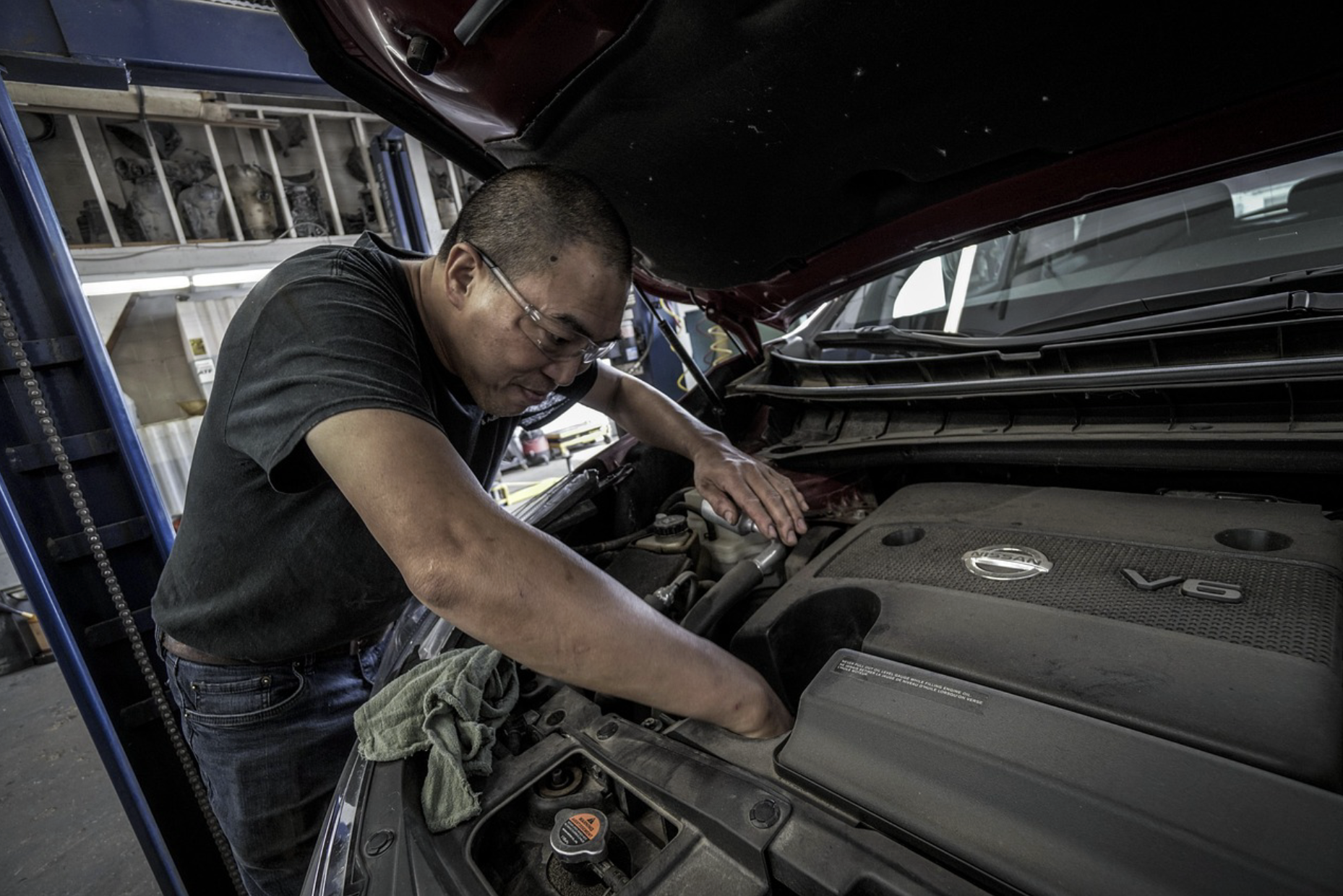
EVs have fewer moving parts than any vehicle with a combustion engine — approximately 20 compared to over 2,000 in a conventional petrol car. That translates to lower servicing costs: no oil changes, no spark plugs, no timing belts, no exhaust system repairs. When compared directly to hybrids, EVs still hold a servicing cost advantage — the big-brand service chains that cater to EV owners typically charge less for their EV service packages than for equivalent hybrid or petrol-vehicle services.
Hybrids, however, are not far behind. While they do have a petrol engine that requires standard servicing (oil, filters, spark plugs), they benefit from regenerative braking, which significantly extends brake pad life. Most hybrid manufacturers offer similar service intervals to petrol cars, and the hybrid-specific components (battery, electric motor, inverter) are designed to be low-maintenance over the vehicle’s lifetime. Toyota, for example, offers an 8–10 year or 160,000 km battery warranty on its hybrid models — effectively covering the battery for the bulk of most ownership periods.
Important note for used import buyers: The manufacturer battery warranty periods above apply to NZ-new vehicles purchased from authorised dealers. Japanese-import (used) hybrids — such as the popular Toyota Aqua, Prius, and Honda Fit Hybrid — typically do not carry the original manufacturer’s warranty in New Zealand. For these vehicles, the battery’s condition depends on its age, mileage, and usage history.
Servicing Factor | BEV | HEV (Petrol Hybrid) |
Oil changes | Not required | Required (standard intervals) |
Brake pad life | Extended (regen braking) | Extended (regen braking) |
Battery warranty | 8 years / varies by mfr | 8–10 years / 160,000 km (Toyota, NZ-new only) |
Est. annual servicing cost | ~$200–$400 | ~$350–$600 |
Specialist technician required? | Yes (high-voltage certified) | No (standard mechanic) |
Note: Servicing costs are indicative and vary by vehicle model, age, and service provider.
The servicing cost gap between EVs and hybrids is real but modest — typically $150–$200 per year in the EV’s favour. However, the hybrid’s advantage is accessibility: any qualified mechanic can service a hybrid, whereas EVs require high-voltage certified technicians, which can limit your options — particularly outside major centres.
Step 7. Compare Depreciation

Depreciation is the hidden cost of vehicle ownership — and it is where EVs currently face their biggest disadvantage. New EVs tend to lose value faster than conventional vehicles in their first few years on the road, driven by rapid technology cycles, shifting government incentives, and buyer uncertainty around battery longevity. Petrol cars and hybrids also depreciate, but typically at a slower and more predictable rate.
Several factors drive faster EV depreciation in New Zealand:
Rapid technology cycles. New EV models with longer range and better technology arrive regularly, making older models less desirable.
Battery degradation concerns. Modern EV batteries degrade slowly under normal use, and most manufacturers offer 8-year battery warranties. However, buyer perception of battery health still weighs on resale values, particularly for older models or those without verifiable battery health data.
Reduced government incentives. The end of the Clean Car Discount has reduced the price premium that EV buyers are willing to pay in the used market.
Hybrids generally hold their value better than EVs. The Toyota RAV4 Hybrid's dominance in the sales charts — and its reputation for reliability and fuel efficiency — supports strong used-market demand. Established hybrid models from Toyota, Honda, and Mazda benefit from well-understood technology, wide parts availability, and decades of reliability data, all of which support resale confidence. That said, depreciation varies significantly by model, condition, mileage, and market conditions, and no NZ-specific resale index currently ranks individual models.
Depreciation is difficult to predict with precision, particularly for newer vehicle categories. Long-term five-year resale data for the current generation of EVs in New Zealand does not yet exist — these vehicles simply have not been on NZ roads long enough. What the available data does show is that EVs have depreciated faster than petrol and hybrid vehicles in the short term, though the gap may narrow as the used EV market matures and buyer confidence grows. For buyers weighing up an EV versus a hybrid, the key takeaway is this: factor depreciation into your total cost of ownership calculation, and be aware that the EV's lower running costs may be partially or fully offset by higher value loss over the ownership period.
Step 8. The Total Running Cost Comparison

Here is the full picture — an indicative five-year comparison of purchase price and ongoing running costs for three representative vehicles, based on the data in this article:
Cost Category (5 years) | Tesla Model Y (BEV) | Toyota RAV4 Hybrid (HEV) | Outlander PHEV |
Purchase price | $67,900 | $49,990 | ~$55,990 |
Fuel + RUC (5 yrs) | ~$6,960 | ~$9,110 | ~$6,170 |
Insurance (5 yrs) | ~$19,628 | ~$13,650 | ~$14,567 |
Rego + ACC (5 yrs) | ~$1,753 | ~$1,112 | ~$1,753 |
Servicing (5 yrs) | ~$1,500 | ~$2,375 | ~$2,375 |
WoF (5 yrs) | ~$425 | ~$425 | ~$425 |
Total: purchase + 5-year running costs | ~$98,166 | ~$76,662 | ~$81,280 |
Note: All figures are indicative estimates based on 2026 data and are intended for comparison purposes only. Actual costs will vary depending on the specific vehicle variant, driver profile, insurer, location, driving habits, and market conditions. Insurance estimates reflect standardised Quashed Market Scan data. Depreciation and resale value are covered separately in Step 7.
The five-year comparison tells a clear story. The petrol hybrid (RAV4) comes in at an estimated $76,662 in purchase price plus running costs — roughly $21,504 less than the Tesla Model Y over the same period. Even though the EV is cheaper to fuel and service, those savings are outweighed by the higher purchase price, more expensive insurance, and additional registration and RUC costs.
The PHEV sits in between, offering excellent fuel economy but carrying a higher purchase price and the added cost of road user charges and EV-rate registration fees.
When you also factor in depreciation — which, as covered in Step 7, currently favours hybrids over EVs — the gap widens further. The hybrid owner is likely to retain more of their vehicle's value at the end of the ownership period, though the exact difference will depend on market conditions at the time of sale.
Insurance alone accounts for a $5,978 difference between the EV and the hybrid over five years. That is money you can control by comparing your options. Use the free Quashed Market Scan to benchmark your premium against 10+ NZ insurers before you buy.
Step 9. The Road User Charges Shakeup: What’s Coming
The current road user charges system is about to change significantly. The New Zealand Government has announced plans to transition all vehicles to a distance-based road user charges system, eventually replacing fuel excise duty (petrol tax) entirely. Transport Minister Simeon Brown confirmed the plan in a March 2026 announcement, describing it as a once-in-a-generation change to how New Zealand funds its roads.
Key milestones announced:
2026: Legislation expected to be passed to modernise the RUC system, including removing the requirement to display physical RUC licences, enabling digital records, and supporting flexible payment models.
2027: The new RUC system opens for business, with third-party providers offering electronic payment solutions.
Beyond 2027: All petrol vehicles will be brought into the RUC system, although no specific date has been set.
What this means for hybrid owners: Petrol hybrids are currently exempt from RUC because they pay fuel excise at the pump. Once the transition happens, hybrids will pay RUC like everyone else. This will add an estimated $874 per year (at the current light vehicle rate of $76 per 1,000 km) to hybrid running costs — though the fuel excise component of petrol pricing should fall correspondingly. The net impact will depend on the final rate structure and transition timeline.
For now, the hybrid’s RUC exemption remains a meaningful cost advantage. The Government has confirmed that the transition will happen, but has not set a date for bringing petrol vehicles (including hybrids) into the RUC system. Until legislation is passed and a timeline is set, hybrid owners continue to benefit from the current exemption.
Final Verdict: The Hybrid Is the Total Cost of Ownership Winner — For Now

On a pure total-cost-of-ownership basis in New Zealand in 2026, the petrol hybrid wins. Lower purchase prices, slower depreciation, cheaper insurance, no road user charges, and the simplicity of never needing to find a charging station make hybrids the most cost-effective electrified option for most Kiwi drivers.
That does not mean an EV is the wrong choice. If you have home charging, do most of your driving within range of charging infrastructure, value zero tailpipe emissions, and are comfortable with the higher upfront and insurance costs, an EV can still make sense — particularly as the technology matures and costs come down. And with over 80% of New Zealand’s electricity generated from renewable sources, the environmental case for EVs remains strong.
PHEVs occupy the practical middle ground — electric driving for the daily commute, petrol range for weekend trips — but their total cost of ownership sits between the two rather than clearly beating either.
The one cost you can control regardless of what you drive is insurance. Whether you choose an EV, hybrid, or PHEV, the spread between the cheapest and most expensive insurer for the same vehicle and driver can be hundreds of dollars per year. Before you buy your next vehicle, take two minutes to run a free Quashed Market Scan. It compares your car insurance against 10+ NZ insurers, it’s free, and it could save you hundreds.
With Quashed, you can make your next vehicle decision with the full cost picture in front of you — not just the sticker price and the fuel bill.
Related Reading
The Quashed team has the guides you need to make smarter insurance decisions at every stage:
EV vs Petrol Car: Total Cost of Ownership in New Zealand 2026 — A full comparison of the total cost of owning an EV against a petrol car in New Zealand.
Electric Vehicles: Do They Cost More to Insure? — Quashed Market Scan data comparing EV, hybrid, and petrol insurance costs across three case studies.
Average Car, House, and Contents Insurance Cost NZ 2026: Monthly Payment Guide — The latest Quashed Index Q4 2025 data on NZ insurance premiums, regional breakdowns, and the loyalty tax.
Guide to Toyota Prius Insurance in NZ — Detailed premium data for one of New Zealand’s most popular hybrid models.
Comprehensive vs Third Party Fire & Theft vs Third Party (Full NZ Breakdown) — A full breakdown of the three levels of car insurance cover available in New Zealand.
Car Ownership Costs NZ 2026: Registration, Insurance & Total Running Costs Explained — The complete 2026 guide to car ownership costs in New Zealand.
How to Save on Petrol in NZ 2026 — Practical tips for reducing your fuel bill in the current high-price environment.
Cheap Car Insurance NZ 2026: Proven Ways to Lower Your Premium — Practical, proven strategies to reduce your car insurance premium without cutting cover.
Choosing Your Next Vehicle: How Car Make and Model Impact Your Insurance in NZ 2026 — How your vehicle choice drives your premium, with real data from Quashed’s Market Scan.
Car Insurance in New Zealand: A Consumer Guide — The essentials of car insurance in New Zealand, from policy types to claims.
Frequently Asked Questions: EV vs Hybrid in New Zealand
Are hybrids cheaper to own than EVs in New Zealand?
On a total cost of ownership basis, yes — in most cases. Hybrids have lower purchase prices, slower depreciation, cheaper insurance, no road user charges, and can be serviced by any mechanic. EVs are cheaper to fuel and have lower servicing costs, but those savings are typically outweighed by the higher upfront cost, steeper depreciation, and more expensive insurance. The gap may narrow as EV prices fall and the technology matures.
Do hybrids pay road user charges in New Zealand?
Petrol hybrids (HEVs) that cannot be plugged in are exempt from road user charges because they pay fuel excise duty at the pump. Plug-in hybrids (PHEVs) pay a reduced RUC rate of $38 per 1,000 km. Battery electric vehicles (BEVs) pay the full rate of $76 per 1,000 km. The Government has announced plans to transition all vehicles to a universal RUC system, with legislation expected in 2026 and the modernised system expected to launch in 2027 — however, no date has been set for when petrol vehicles (including hybrids) will be required to enter the system.
Is hybrid car insurance cheaper than EV insurance?
Generally, yes. Quashed Market Scan data shows that hybrids from established manufacturers like Toyota tend to attract lower premiums than equivalent EVs. This is primarily because hybrids use well-understood technology, share parts with conventional petrol vehicles, and have established repair networks. EVs carry higher premiums due to specialist repair requirements, expensive battery systems, and limited parts availability for some models. Run a free Quashed Market Scan to see how your specific vehicle compares.
Will the Toyota RAV4 Hybrid hold its value?
The RAV4 Hybrid has been New Zealand’s best-selling vehicle for multiple years and has a strong reputation for reliability and fuel efficiency. High demand in both the new and used markets, combined with Toyota’s established brand value, means the RAV4 Hybrid typically depreciates more slowly than both EVs and many other SUVs. However, resale values are always subject to market conditions and are not guaranteed.
What happens when a hybrid battery needs replacing?
Sudden hybrid battery failure is rare. What typically happens is gradual capacity loss over many years. Most manufacturers offer 8–10 year or 160,000 km warranties on hybrid batteries. If a replacement is needed after the warranty period, costs can range from $3,000 to $8,000 depending on the model. However, many hybrid batteries outlast the vehicles they are fitted to, particularly in Toyota and Honda models where reliability data spans over two decades.
How much does car insurance cost in New Zealand?
The average cost of comprehensive car insurance in New Zealand is $1,298 per year ($108 per month) as of Q4 2025, based on Quashed Index data. Auckland drivers pay an average of $1,510 per year. Quashed users who compared their car insurance found cheaper cover 80% of the time, with average savings of $367 per year. Run a free Quashed Market Scan to see how your premium compares.
Should I buy an EV or a hybrid in 2026?
We recommend you buy a hybrid over an EV. However, it depends on your priorities and circumstances. If minimising total cost of ownership is your primary goal, a petrol hybrid is likely the more cost-effective choice in 2026. If zero emissions, cutting-edge technology, and the cheapest per-kilometre running costs matter most to you, an EV may be the right fit — provided you have access to home charging and can absorb the higher upfront and insurance costs. Either way, compare your insurance options before you buy.
Still have questions? Visit Quashed for more plain-English guides to car insurance in New Zealand, or run a free Market Scan to compare your options in under two minutes.
This article provides general information only and does not constitute legal or financial advice. Insurance policies vary between providers. For full details, refer to Quashed’s terms and conditions.

